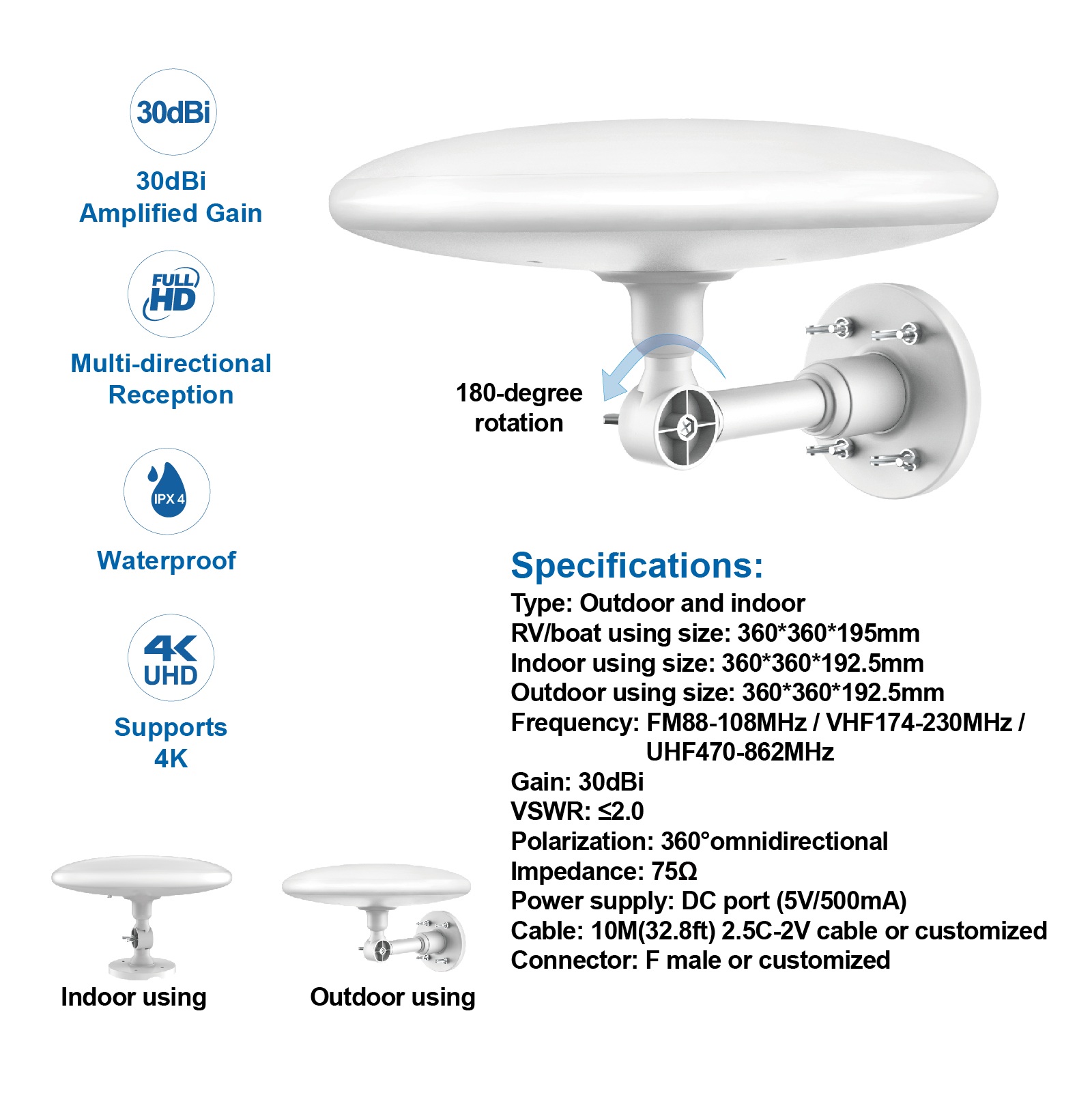
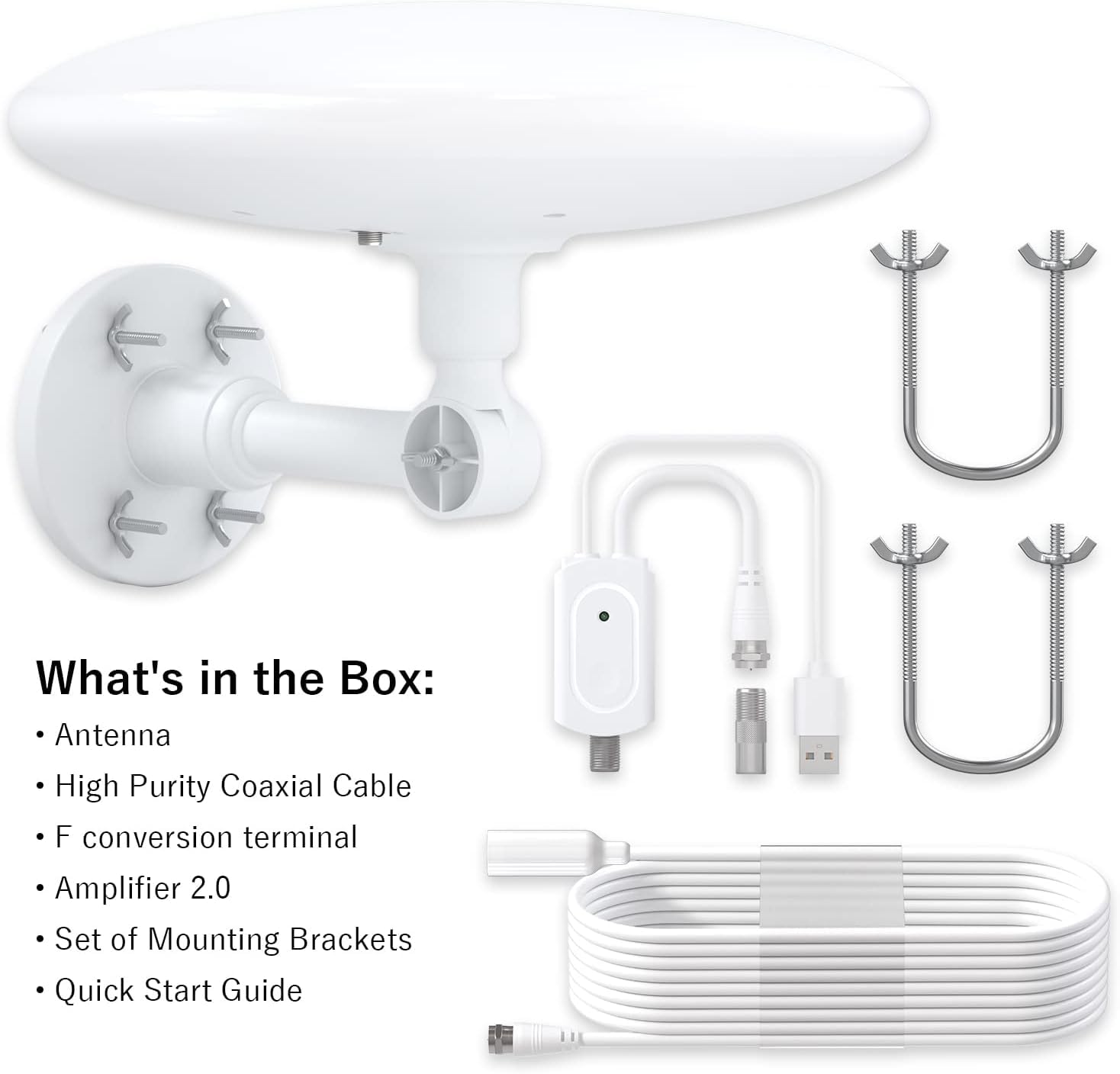

The outdoor TV Antenna — long overshadowed by the indoor antenna boom in urban cord-cutting markets — is having its own breakout moment. Valued at $5.18 billion globally in 2026 and projected to more than double to $10.68 billion by 2033, the outdoor antenna segment is growing nearly twice as fast as the broader TV Antenna category. The forces driving it are not the streaming subscription fatigue that fuels indoor antenna sales in city apartments, but something deeper: persistent rural broadband gaps, increasingly extreme weather, and a structural shift in how Americans think about communication resilience.
Outdoor Antenna Market at a Glance — July 2026$5.18 Billion — Global outdoor antenna market value in 2026 (Coherent Market Insights)
$10.68 Billion — Projected market size by 2033
10.9% CAGR — Annual growth rate, nearly double the indoor antenna segment
$3.87 Billion — Global Digital tv antenna market across all types in 2026 (Report Prime)
$230–$600 — Typical professional outdoor antenna installation cost in the US (HomeAdvisor, 2026)
71% — Rural US households with home broadband in 2025, up from 58% in 2018 (Pew Research)
$47 Billion — Federal funding allocated to rural broadband expansion programs
Why Outdoor Antennas Are Growing Twice as Fast as the Rest of the Market
At first glance, the outdoor antenna's 10.9 percent compound annual growth rate seems surprising. Indoor antennas are cheaper, easier to install, and benefit directly from the urban cord-cutting narrative that dominates media coverage. But the outdoor segment's growth reflects structural demand that the indoor category cannot address.
The most fundamental driver is geography. Approximately 29 percent of rural American households still lacked home broadband in 2025, according to Pew Research Center data — an improvement from 42 percent in 2018, but a persistent gap that makes streaming-dependent television unreliable or impossible for tens of millions of people. Federal programs have allocated nearly $47 billion to rural broadband expansion, with construction accelerating through 2026, but the buildout will take years. In the interim, an outdoor antenna mounted on a rooftop or mast delivers free, crystal-clear high-definition television with zero dependence on internet infrastructure. For a rural household that cannot reliably stream, the outdoor antenna is not a supplement to streaming — it is the primary television source.
The second driver is the widening gap between what indoor and outdoor antennas can realistically receive. An indoor antenna in a suburban home at 30 miles from broadcast towers might pull in 40 channels. The same household, upgrading to a rooftop Yagi or multi-bay outdoor antenna mounted 25 feet above ground, might receive 60 to 80-plus channels — including stations from adjacent markets that the indoor antenna cannot detect at all. The physics is straightforward: height above the roofline eliminates building penetration losses, and larger outdoor antenna elements with higher gain capture more signal energy. For households at 40 to 70 miles from towers — a common scenario in rural and exurban America — the outdoor antenna is the difference between zero channels and reliable multi-network reception.
"An indoor antenna is a convenience purchase. An outdoor antenna is an infrastructure investment. One buys you free TV for a room. The other buys you free TV for a household, for decades."
Extreme Weather and the Resilience Premium
A newer and increasingly significant demand driver for outdoor antennas is extreme weather resilience. As hurricanes, wildfires, ice storms, and derechos become more frequent and more intense — a pattern that climate data from NOAA and the National Weather Service has documented across the 2020s — consumers are reassessing which home technologies remain functional when infrastructure fails.
An outdoor antenna connected directly to a television does not require internet, does not depend on cellular networks, and does not rely on cloud servers in a data center hundreds of miles away. When a hurricane knocks out broadband and cellular service for days or weeks — as Hurricanes Helene and Milton demonstrated in 2024 — the antenna continues to receive local broadcast signals as long as the television has power. Emergency weather updates, evacuation information, and news coverage arrive free over the air without any dependence on damaged infrastructure. This resilience argument is moving outdoor antennas from the "home theater accessory" category into the "emergency preparedness" category in consumer decision-making.
Manufacturers have responded by emphasizing weather durability in product design and marketing. Storm-proof outdoor antenna models — engineered with reinforced mounting brackets, corrosion-resistant aluminum elements, UV-stabilized housings, and wind survival ratings of 90 to 110 mph — are now a distinct subcategory. Some manufacturers offer lifetime warranties specifically tied to weather damage, a signal of confidence in the engineering and a competitive differentiator in a market where the antenna is expected to survive on a rooftop for 15 to 20 years. The hurricane-prone Gulf Coast, tornado-alley states, and wildfire-vulnerable western regions represent concentrated demand zones where weather resilience is the primary purchase consideration.
The Rural Broadband Gap: $47 Billion and Years Away from Resolution
The federal government's response to the rural digital divide is unprecedented in scale — nearly $47 billion allocated through programs including the Broadband Equity, Access, and Deployment (BEAD) program, the Rural Digital Opportunity Fund, and the ReConnect Loan and Grant Program. Construction activity accelerated through 2025 and into 2026, with fiber optic cable being trenched into rural communities that have waited decades for high-speed internet.
But the timeline is long. BEAD-funded projects face supply chain constraints for fiber optic cable and networking equipment, labor shortages among qualified installation crews, and the sheer geographic challenge of running fiber to communities where homes are separated by miles rather than feet. Even under optimistic deployment scenarioses, universal rural broadband access in the United States will not be achieved until the early 2030s. For the millions of rural households in the gap — those who have waited years for broadband that remains "coming soon" — the outdoor antenna is a here-and-now solution that costs less than two months of a satellite TV subscription and lasts two decades.
This dynamic creates an unusual market profile for outdoor antennas: demand is strongest precisely where competing technologies are weakest. Urban and dense suburban areas, well-served by broadband and close to broadcast towers, can get by with indoor antennas or streaming alone. Rural areas — distant from towers, underserved by broadband — need outdoor antennas most, and represent the fastest-growing customer segment. The market is, in effect, inversely correlated with infrastructure quality: the worse the broadband, the stronger the antenna demand.
The Professional Installation Economy
Unlike indoor antennas — a plug-and-play, no-tools category — outdoor antennas create downstream economic activity through professional installation. HomeAdvisor's 2026 cost data places typical outdoor antenna installation between $230 and $600, covering the mounting hardware, mast or tripods, coaxial cable routing, grounding per National Electrical Code requirements, weatherproofing of all exterior connections, and the labor of working safely at roof height.
This installation economy supports a network of local contractors, electricians, and specialized antenna installers whose services are often bundled with related home improvement projects — roof replacements, solar panel installations, exterior renovations. The rise of the outdoor antenna market is creating skilled-trade demand in communities where broadband infrastructure work is also creating jobs, producing a complementary economic effect in rural areas.
The DIY-versus-professional decision splits along predictable lines. Homeowners comfortable with roof work, ladder safety, and basic electrical grounding can self-install a moderate-complexity outdoor antenna in a weekend for $100 to $250 in materials. Those who are uncomfortable with heights, uncertain about grounding requirements, or mounting antennas in exposed high-wind locationss overwhelmingly choose professional installation. The safety risk — a fall from roof height, or contact with overhead power lines — is not theoretical, and the NEC grounding requirements are legally mandatory, not optional. The $230 to $600 professional installation cost is, for most consumers, a safety and compliance investment rather than a luxury.
Technology Shifts: ATSC 3.0, 5G Filtering, and Smarter Outdoor Antennas
The outdoor antenna product landscape in 2026 reflects several technology shifts that improve performance and expand the addressable market.
ATSC 3.0 compatibility is now a standard claim on outdoor antenna packaging, though the antenna itself requires no modification for NextGen TV — any UHF/VHF antenna receives ATSC 3.0 signals. What has changed is the antenna-plus-tuner ecosystem: outdoor antennas are increasingly bundled with or marketed alongside ATSC 3.0 set-top boxes, creating a complete "NextGen TV ready" package for consumers who own older televisions without built-in ATSC 3.0 tuners. As ATSC 3.0 deployment now covers 75-plus US markets and Brazil's DTV+ adoption adds international momentum, the outdoor antenna is positioned as the reception hardware for the next decade of broadcast television.
Integrated 5G filtering has transitioned from an aftermarket accessory to a built-in feature on mid-range and premium outdoor antennas. Cellular base stations operating in frequency bands immediately above the UHF television spectrum can overload TV tuners even when the antenna is not tuned to cellular frequencies. Outdoor antennas — mounted high, exposed to strong cellular signals from nearby towers — are more susceptible to this interference than indoor models. Modern outdoor antennas now incorporate band-pass filters within the amplifier housing or the balun enclosure, blocking cellular signals above 698 MHz with minimal insertion loss in the television band.
Rotor and smart-aiming technology addresses one of the historic pain points of directional outdoor antennas: the need to physically re-aim the antenna when desired stations broadcast from towers in different directions. Programmable antenna rotors with remote-control presets allow consumers to store multiple compass headings and switch between them with a button press. Emerging smart-rotor systems integrate with TV tuners to automatically rotate the antenna to the correct bearing when a channel is selected — eliminating the manual aiming step entirely. These systems add cost but transform the user experience for households in markets where towers are spread across a wide compass arc.
Multi-bay UHF arrays with supplemental VHF elements represent the current state of the art in all-in-one outdoor antenna design. By combining a high-gain UHF bowtie array — typically four or eight bays — with dedicated VHF dipole elements on the same mast, these antennas deliver consistent performance across the full television broadcast spectrum without requiring separate VHF and UHF antennas and a signal combiner. For consumers in markets where major network affiliates are split between VHF and UHF, this integrated approach simplifies installation and improves reliability.
The International Dimension
While North America dominates the outdoor antenna market — reflecting the combination of high broadcast tower density, cord-cutting rates, and rural geography — international markets are contributing to growth at different stages of maturity.
Europe's DVB-T2 infrastructure supports a stable replacement-cycle market, with growth concentrated in Eastern European countries where digital switchovers are more recent. Asia-Pacific presents the largest long-term opportunity: India's digital transition and massive rural population create an addressable market measured in hundreds of millions of households, though extreme price sensitivity limits the premium outdoor antenna segment. Japan's ISDB-T ecosystem supports a mature, quality-focused market. Southeast Asian markets including Vietnam, Indonesia, and the Philippines are experiencing accelerating demand as urban populations expand and digital broadcast infrastructure reaches previously unserved areas.
Brazil's adoption of ATSC 3.0 technologies — branded as DTV+ — in August 2025 creates a new regional market in Latin America where outdoor antennas will be the primary reception hardware as the country transitions its broadcast infrastructure. The Middle East and Africa remain early-stage markets where growth tracks closely with digital transition timelines and urbanization rates.
Outlook: The Outdoor Antenna's Second Act
The outdoor antenna market's trajectory through the remainder of the 2020s is supported by structural demand drivers that show no sign of weakening. Rural broadband will improve — the $47 billion in federal funding ensures that — but the buildout timeline means the antenna remains the best available option for millions of households through at least 2030. Extreme weather events are projected to increase in frequency and severity, strengthening the resilience argument for internet-independent television. ATSC 3.0 deployment will expand, increasing the value of the receivable broadcast signal. And cord-cutting will continue, with each former cable subscriber representing a potential outdoor antenna customer if indoor reception proves insufficient at their locations.
The outdoor antenna's unlikely resurgence — from obsolete rural technology to growth-market infrastructure — is a story about the gap between what digital infrastructure promises and what it actually delivers, on what timeline, and at what cost. As long as that gap exists, the rooftop antenna will have a market — and right now, that gap is measured in billions of dollars and millions of households.

 Español
 Portugues
 Pусский
 Français
 Deutsch
 日本語
日本語
 한국어
한국어
 العربية
 Italiano
 Nederlands
 Ελληνικά
 Svenska
 Polski
 ไทย
ไทย
 Türk dili
 हिन्दी
 Indonesia
 Melayu
 Tiếng Việt
 中文
中文
 dansk
dansk
 Magyar
 қазақ
қазақ
 বাংলা
বাংলা
 עִברִית
 čeština
 Soomaali
 မြန်မာ
 فارسی
فارسی
 українська
 norsk
norsk
 Gaeilge
 беларускі
 Română
 ພາສາລາວ
 Filipino
 lietuvių
 Cymraeg
 македонски
 Suomalainen
 slovenský
 o'zbek
 اردو
اردو
 հայերեն
 Igbo
Igbo
 български
 سنڌي
سنڌي
 Shona
Shona
 සිංහල
සිංහල
 Hrvatski
 íslenskur
 galego
 català
 Zulu South Africa
 Afrikaans isiXhosa
 ಕನ್ನಡ
ಕನ್ನಡ
 lëtzebuergesch
 Indonésia Sunda
 Кыргызча
 тоҷикӣ
 Србија
 Twi
Twi
 Hawaii
 Cebu
Cebu
 नेपाल
नेपाल
 euskara
 frissi
 יידיש
יידיש
 latvija
 slovenija
 kiswahili
 ਪੰਜਾਬ
ਪੰਜਾਬ
 پښتو
پښتو
 საქართველოს
 hua moni
 bosna
bosna
 Kreyòl ayisyen
 Eesti
Eesti
 Gàidhlig na h-Alba
 Samoa
Samoa
 Монгол
 Azərbaycan
 አማራ
አማራ
 Shqipëria
 Malagasy
 Malta
Malta
 ខ្មែរ
ខ្មែរ
 Chicheva
 中文(繁體)
 ଓଡିଆ
ଓଡିଆ
 Setswana
 Afrikaans
 Aymara
 Башҡорт
 Türkmenler
 ትግሪኛ
ትግሪኛ
 Afaan Oromoo
 অসমীয়া
 Kinyarwanda
 Ilocano
 Wolof
Wolof
 अवधी
अवधी
 Oluganda
 Bikol
Bikol
 Fulɓe
Fulɓe
 Kikongo
 Sango
Sango
 ދިވެހި
 Lingala
 मैथिली
 Tsonga
 ꯃꯦꯏ ꯊꯥꯏ꯫
 brezhoneg
 Furlan
 नेवा
नेवा
 རྫོང་ཁ
 Santali
 Аҧсуа
Аҧсуа
 Нохчийн
 Чӑваш
Чӑваш
 Татар
Татар
 Batak Karo
 دری
دری
 Diura
Diura
 Fengyu
 Eʋegbe
 Iban
Iban
 Fiji
Fiji
 Tonga
Tonga
 Inuktitut
 Nahuatl
 maaya yucatec
 Runasimi
 guarani
 Qafar
Qafar
 Acholi
 Dinka
Dinka
 Luo
Luo
 Lundi
Lundi
 isiNdebele
 Tshivenḓa
 Sesotho sa Leboa
 Sesotho sa Borwa
 Ndumbe
 Papuan Pidgin
 Rromani ćhib
 Thok Nath





 WhatsApp
 phones
Comment
(0)