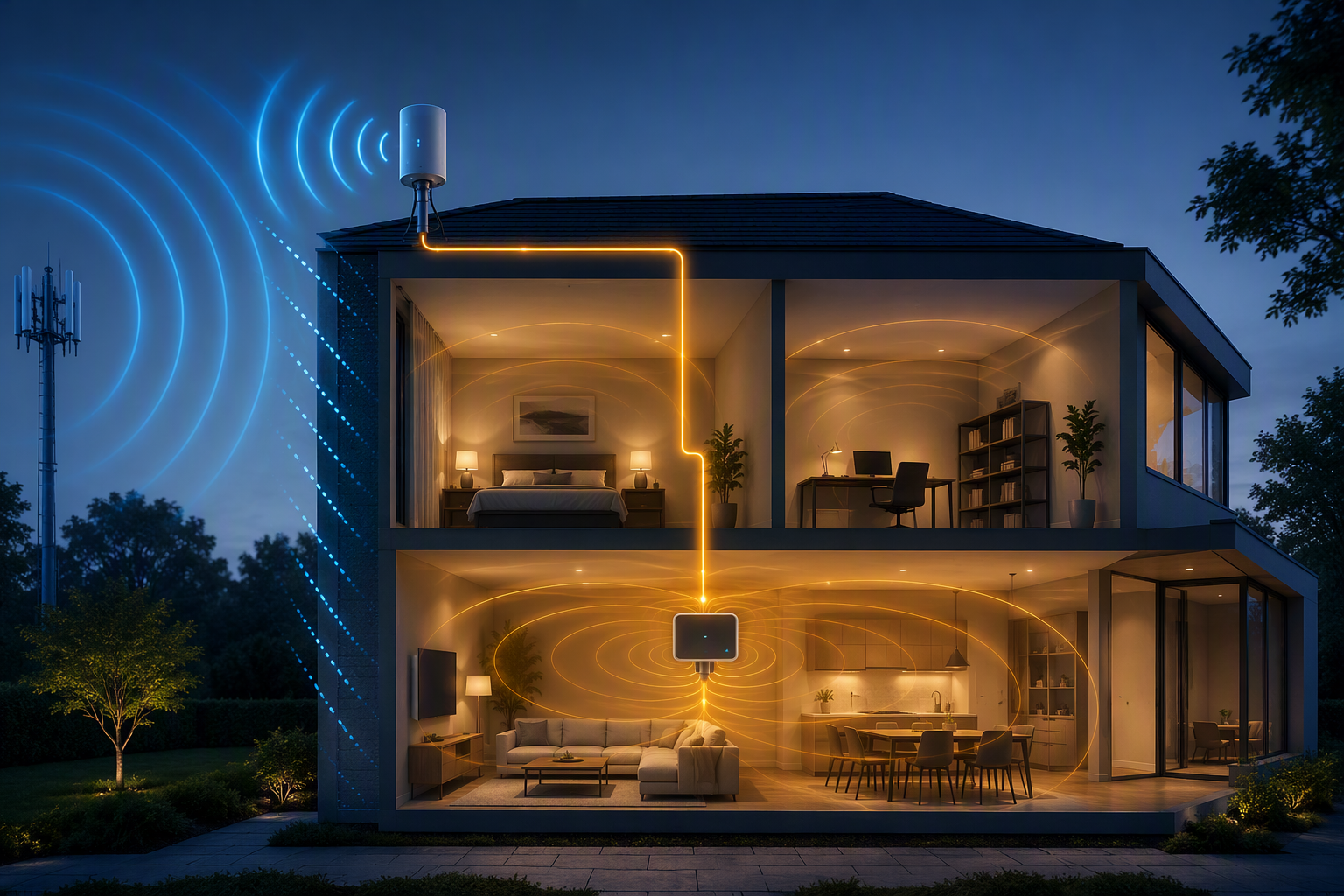
The promise of 5G was ubiquitous, lightning-fast connectivity everywhere. The reality, three years into the rollout, is more complicated. Millimeter-wave 5G can deliver multi-gigabit speeds — but it cannot penetrate a window. C-band 5G offers a compromise between speed and range — but it struggles with walls, metal siding, and low-E glass. The fastest 5G is an outdoor technology. And that fundamental mismatch — between where 5G works and where people use their phoness — is driving the signal booster market to $20.59 billion in 2026, growing at rates of 9 to 17 percent annually. The irony is sharp: the more advanced cellular technology becomes, the more it needs help getting indoors.
Signal Booster Market at a Glance — August 2026$20.59 Billion — Global signal booster market size in 2026 (Business Research Insights)
$60.75 Billion — Projected market size by 2033
12.78% CAGR — Broad signal booster market growth rate through 2033
17.4% CAGR — Cellular signal repeater segment growth rate (InsightAce Analytic)
$1.5 Billion — mobiles Signal Booster hardware market in 2026 (360 Research Reports)
$10.73 Billion — Global small cell 5G market, growing at 37.9% CAGR (Fortune Business Insights)
May 2026 — AT&T, T-mobiles, Verizon announce joint venture to eliminate rural dead zones
5G's Physics Problem: Why Faster Means Shorter Range
The core of 5G's indoor coverage challenge is physical, not commercial. Radio waves at higher frequencies carry more data but travel shorter distances and penetrate obstacles far less effectively. This is not a temporary limitation that engineering will eventually overcome — it is the electromagnetic spectrum behaving exactly as physics predicts.
Millimeter-wave 5G, operating at 24 to 40 GHz — the bands that deliver the multi-gigabit speeds featured in carrier advertisements — has a range measured in hundreds of feet outdoors and is effectively blocked by a single pane of glass. A mmWave signal that is strong on the sidewalk outside a building is undetectable three feet inside. C-band 5G, at 3.7 to 3.98 GHz, offers a compromise: better range and penetration than mmWave, but significantly worse indoor performance than the low-band LTE frequencies that carriers have used for years. Building materials that were merely inconvenient for 4G — metal siding, concrete walls, low-E energy-efficient windows, brick veneer, radiant barrier insulation — are effectively opaque to mid-band and high-band 5G.
The result is a growing disconnect between the cellular experience outdoors and indoors. A consumer standing on their front porch may see a 5G ultra-wideband indicator and a speed test showing 800 Mbps. They walk inside, close the door, and the phones drops to a single bar of LTE — or loses service entirely. This is not a network problem in the traditional sense. The tower is working. The signal is strong at the point of transmission. It simply cannot reach the consumer where they actually use their phones — which, for the average American, is approximately 80 percent of the time indoors.
"The fastest 5G lives outdoors. The problem is that people don't. The signal booster industry exists to solve that gap — and the gap is growing faster than the networks can fill it."
The Three-Pronged Solution: Small Cells, Wi-Fi Calling, and Signal Boosters
The wireless industry is pursuing three strategies to solve the indoor coverage problem, and they are not mutually exclusive — but they serve different use cases at different price points.
Small cells — miniature cellular base stations deployed on streetlights, utility poles, and building exteriors — are the carrier-driven solution. The global small cell 5G network market is valued at $10.73 billion in 2026, growing at a staggering 37.9 percent CAGR to a projected $140.27 billion by 2034. Small cells effectively extend the cellular network closer to the user, reducing the distance the signal must travel and improving indoor penetration by shortening the outdoor path. But small cells require carrier deployment, municipal permitting, power, and fiber backhaul. They are infrastructure projects, measured in years, that address coverage at a neighborhood level — not in a specific living room or office.
Wi-Fi calling is the software solution. Every modern smartphones can route calls and texts over a Wi-Fi network when cellular signal is weak. Wi-Fi calling costs nothing, requires no additional hardware beyond a Wi-Fi router, and works anywhere with broadband internet. Its limitation is that it does not solve the underlying cellular problem — it bypasses it. Wi-Fi calling works only where Wi-Fi exists. It does not help with SMS to non-iMessage contacts, does not support all cellular features, and does nothing for data connectivity when Wi-Fi is unavailable. For homes with reliable broadband, Wi-Fi calling is a free and effective complement to cellular service. For homes without broadband — and for vehicles, outdoor workspaces, and emergency situations — it is not a solution at all.
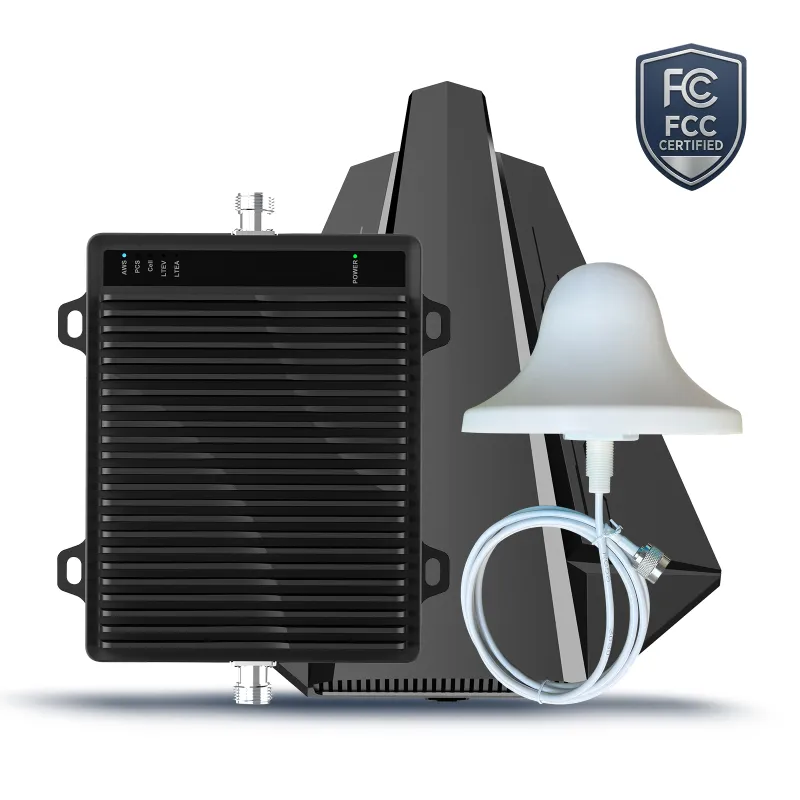
Signal boosters are the hardware solution. A $200 to $1,000 system — outdoor Antenna, amplifier, indoor antenna — captures the outdoor cellular signal, amplifies it by 50 to 100 dB, and rebroadcasts it indoors. The booster does not require broadband. It does not require carrier infrastructure deployment. It works for every phones on every carrier within the supported frequency bands. And — critically — it is the only solution that actually improves the cellular signal itself rather than routing around it. For the rural home 10 miles from the nearest tower, for the metal-walled warehouse, for the basement office, and for the vehicle traveling through dead zones, the signal booster is often the only practical path to reliable cellular service.
May 2026: The Carriers Acknowledge the Problem
In May 2026, AT&T, T-mobiles, and Verizon announced a joint venture to eliminate wireless dead zones across rural America — a rare cooperative move from companies that otherwise compete aggressively. The plan, reported by Reuters, aims to "end nearly all dead zones without mobiles service" through shared infrastructure investment. The joint venture is both a validation of the coverage problem's severity and an acknowledgment that no single carrier can solve it alone.
The joint venture's focus on rural dead zones is significant because rural areas are where the signal booster market is growing fastest. Urban and suburban consumers have alternatives — small cells, Wi-Fi calling, and dense tower networks that provide multiple signal paths. Rural consumers have none of these. A rural home 10 or 15 miles from the nearest tower, surrounded by trees and terrain, has one option for reliable cellular service: a signal booster. The carrier joint venture may eventually reduce the number of truly signal-free locationss, but infrastructure buildout takes years. For the rural consumer with a dead zone today, the booster is the immediate solution. The infrastructure investment, when it arrives, will make the booster work better — not replace it.
The Market by the Numbers: 9 to 17 Percent Growth, Depending on How You Count
The signal booster market's size varies dramatically depending on how broadly the category is defined, but the growth trajectory is consistent across every definition. Business Research Insights values the broad signal booster market — encompassing consumer cellular boosters, commercial DAS components, public safety repeaters, and vehicular boosters — at $20.59 billion in 2026, projecting growth to $60.75 billion by 2033 at a 12.78 percent compound annual growth rate.
The narrower consumer mobiles signal booster market is smaller but growing faster. 360 Research Reports estimates $1.5 billion in 2026, reaching $2.73 billion by 2035. Cognitive Market Research projects the Cell phones Signal Booster segment specifically at 11.08 percent CAGR through 2033. InsightAce Analytic's cellular signal repeater report shows the highest growth rate at 17.4 percent CAGR — reflecting the rapid expansion of both consumer and commercial repeater deployments as 5G indoor coverage challenges intensify. Mordor Intelligence had the mobiles signal booster market at $10.16 billion in 2025 and projects $15.35 billion by 2030 at 8.6 percent CAGR — more conservative but still robust.
The variation in market size estimates reflects genuine definitional ambiguity — does "signal booster" include commercial DAS systems? public safety repeaters? vehicular boosters? — but the directional consensus is unambiguous. Every major research firm, using every market definition, projects sustained high-single-digit to mid-teens annual growth for the signal booster category through at least 2033. The underlying drivers — 5G indoor penetration challenges, persistent rural coverage gaps, and growing consumer dependence on reliable cellular connectivity for work, safety, and daily life — are structural, not cyclical.
Product Innovation: The Booster Market Grows Up
The signal booster product landscape in 2026 looks fundamentally different from the commodity amplifiers that dominated the category five years ago. Several technology shifts are expanding both the addressable market and the average selling price.
5G C-band support is now standard on mid-range and premium boosters. C-band at 3.7 to 3.98 GHz is the most commercially significant 5G band — it offers the best balance of speed and coverage for the carriers that hold the most C-band spectrum (Verizon and AT&T). Boosters that support C-band alongside the traditional LTE bands (700, 850, 1900, 2100 MHz) provide comprehensive 4G and 5G coverage from a single system. The premium for C-band support is narrowing as the technology matures, and C-band boosters are migrating from the professional-installation segment into the consumer self-install market.
Multi-carrier gain improvements are closing the gap between broadband and single-carrier performance. Historically, multi-carrier boosters were limited to 64–72 dB of gain by FCC rules designed to prevent inter-carrier interference, while single-carrier boosters could achieve up to 100 dB. Advances in filtering and automatic gain control are allowing multi-carrier boosters to operate closer to their FCC limits across all bands simultaneously, improving real-world performance without requiring separate boosters for each carrier.
Smartphones app integration is transforming the installation and monitoring experience. Boosters now ship with companion apps that display real-time signal strength at the outdoor and indoor Antennas, guide the user through antenna aiming with visual feedback, automatically detect oscillation and suggest antenna repositioning, and provide coverage maps of the boosted area. This addresses one of the category's historic pain points: the trial-and-error process of positioning antennas to maximize gain while avoiding feedback. The app-guided installation turns a process that previously required professional expertise into one that a consumer can complete in 30 to 60 minutes.
Commercial-to-consumer trickle-down is bringing enterprise-grade performance into the home. Features that were exclusive to $5,000–$50,000 commercial DAS installations five years ago — automatic gain control, band-specific amplification, remote monitoring, oscillation detection with automatic band shutdown and recovery — are now available in $300–$600 consumer boosters. This is expanding the addressable market upward: homeowners who previously considered a consumer booster inadequate and a commercial system unaffordable are finding mid-range products that split the difference.
What Comes Next: The Signal Booster's Role in the 5G Ecosystem
The signal booster market's growth trajectory is supported by structural dynamics that will persist regardless of how fast 5G networks expand. Small cells will cover urban corridors and suburban downtowns, but they will never be cost-effective for rural homes spaced miles apart. Wi-Fi calling will serve connected homes, but the quarter of rural households without broadband will remain dependent on cellular for their primary connectivity. 5G will get faster, but it will not get better at penetrating walls — physics does not negotiate with spectrum allocations. The signal booster fills the gap between what cellular networks can deliver outdoors and what consumers need indoors — and that gap, far from closing, is widening as networks push into higher-frequency bands that offer more speed but less coverage.
The carrier dead zone joint venture, the small cell buildout, and the continued expansion of 5G coverage will all make signal boosters more useful, not less. Every new tower that reaches a previously unserved area creates a signal that a booster can capture and amplify. Every small cell that improves outdoor coverage in a suburban neighborhood improves the outdoor signal that a nearby home's booster uses as input. The booster is not an alternative to network expansion. It is a complement — the device that takes the expanded network's outdoor signal and brings it the last 50 feet indoors, where the consumer actually lives.
The Bottom Line
The signal booster market finds itself in a position that few consumer electronics categories achieve: its core value proposition improves as the underlying technology it depends on advances. Every new 5G band, every new tower, every improvement in outdoor coverage makes the outdoor signal stronger — which makes the indoor booster's job easier and its effective coverage area larger. At the same time, every push to higher frequencies makes the indoor problem worse — which makes the booster more necessary. The $20.59 billion signal booster market is not growing despite 5G. It is growing because of 5G. And the faster 5G gets, the more it will need help getting through the front door.

 Español
 Portugues
 Pусский
 Français
 Deutsch
 日本語
日本語
 한국어
한국어
 العربية
 Italiano
 Nederlands
 Ελληνικά
 Svenska
 Polski
 ไทย
ไทย
 Türk dili
 हिन्दी
 Indonesia
 Melayu
 Tiếng Việt
 中文
中文
 dansk
dansk
 Magyar
 қазақ
қазақ
 বাংলা
বাংলা
 עִברִית
 čeština
 Soomaali
 မြန်မာ
 فارسی
فارسی
 українська
 norsk
norsk
 Gaeilge
 беларускі
 Română
 ພາສາລາວ
 Filipino
 lietuvių
 Cymraeg
 македонски
 Suomalainen
 slovenský
 o'zbek
 اردو
اردو
 հայերեն
 Igbo
Igbo
 български
 سنڌي
سنڌي
 Shona
Shona
 සිංහල
සිංහල
 Hrvatski
 íslenskur
 galego
 català
 Zulu South Africa
 Afrikaans isiXhosa
 ಕನ್ನಡ
ಕನ್ನಡ
 lëtzebuergesch
 Indonésia Sunda
 Кыргызча
 тоҷикӣ
 Србија
 Twi
Twi
 Hawaii
 Cebu
Cebu
 नेपाल
नेपाल
 euskara
 frissi
 יידיש
יידיש
 latvija
 slovenija
 kiswahili
 ਪੰਜਾਬ
ਪੰਜਾਬ
 پښتو
پښتو
 საქართველოს
 hua moni
 bosna
bosna
 Kreyòl ayisyen
 Eesti
Eesti
 Gàidhlig na h-Alba
 Samoa
Samoa
 Монгол
 Azərbaycan
 አማራ
አማራ
 Shqipëria
 Malagasy
 Malta
Malta
 ខ្មែរ
ខ្មែរ
 Chicheva
 中文(繁體)
 ଓଡିଆ
ଓଡିଆ
 Setswana
 Afrikaans
 Aymara
 Башҡорт
 Türkmenler
 ትግሪኛ
ትግሪኛ
 Afaan Oromoo
 অসমীয়া
 Kinyarwanda
 Ilocano
 Wolof
Wolof
 अवधी
अवधी
 Oluganda
 Bikol
Bikol
 Fulɓe
Fulɓe
 Kikongo
 Sango
Sango
 ދިވެހި
 Lingala
 मैथिली
 Tsonga
 ꯃꯦꯏ ꯊꯥꯏ꯫
 brezhoneg
 Furlan
 नेवा
नेवा
 རྫོང་ཁ
 Santali
 Аҧсуа
Аҧсуа
 Нохчийн
 Чӑваш
Чӑваш
 Татар
Татар
 Batak Karo
 دری
دری
 Diura
Diura
 Fengyu
 Eʋegbe
 Iban
Iban
 Fiji
Fiji
 Tonga
Tonga
 Inuktitut
 Nahuatl
 maaya yucatec
 Runasimi
 guarani
 Qafar
Qafar
 Acholi
 Dinka
Dinka
 Luo
Luo
 Lundi
Lundi
 isiNdebele
 Tshivenḓa
 Sesotho sa Leboa
 Sesotho sa Borwa
 Ndumbe
 Papuan Pidgin
 Rromani ćhib
 Thok Nath





 WhatsApp
 phones
Comment
(0)